Why a new AC can still leave hot rooms when the ductwork is bad
Your air conditioner is only as good as the pipes that carry its air, and most of them are in a place you never see.
October 21, 2026 · 3 min read
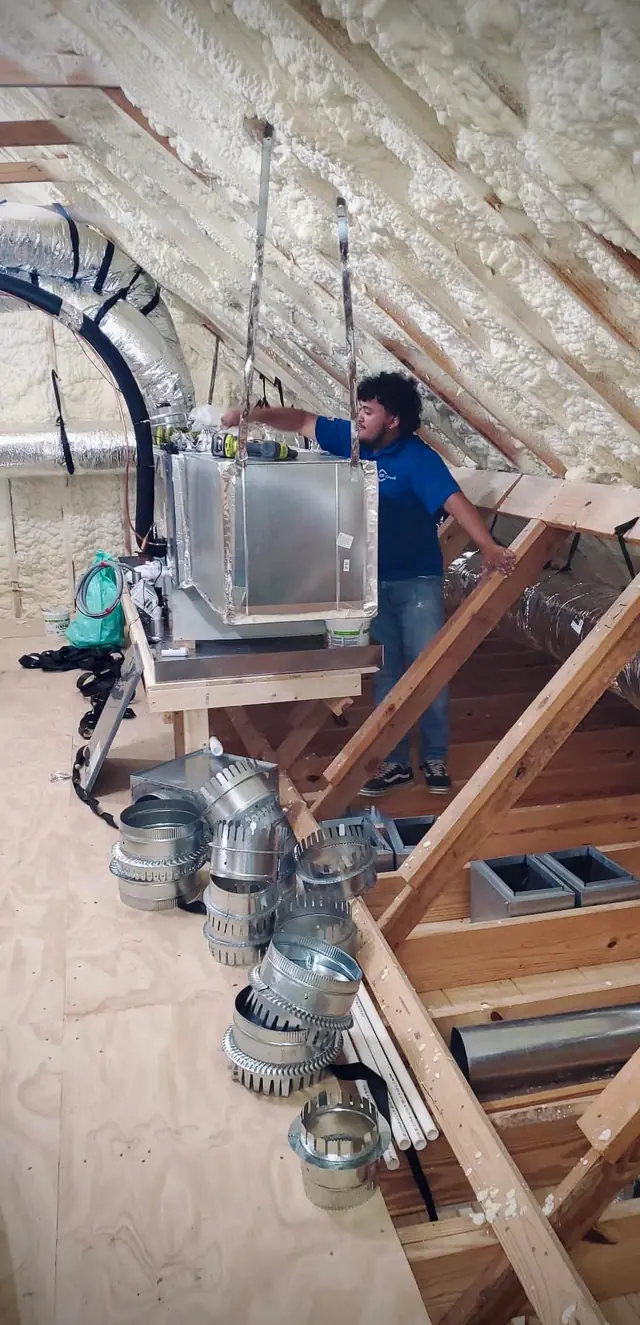
Here is a story contractors hear all the time. A homeowner replaces a worn-out air conditioner with a shiny new one. The summer arrives, and the back bedroom is still ten degrees warmer than the rest of the house. The new equipment is not to blame. The ductwork was, and it was never touched.
In most Houston-area homes the ducts run through the attic, where summer air is far hotter than the outdoors. That makes duct condition a bigger deal here than almost anywhere. A good system pushes cold air through a hot place, and every flaw in the path costs you cooling.
Leaks: cold air going to the wrong place
Ducts are assembled from sections, collars, boots and fittings, and every joint is a chance to leak. In an attic, a leak means you are paying to cool the attic. A disconnected run is the extreme version: air pours into the insulation while a room at the end of the line gets almost nothing.
Leaks also work in reverse on the return side. A leaky return pulls in hot, dusty attic air, which adds heat the system has to remove and sends dust into your equipment and your rooms.
Crushed and kinked flexible duct
Flexible duct is common because it is easy to install. It is also easy to install badly. A run that is pinched under a joist, stretched too tight around a corner or left sagging between supports can lose a lot of its airflow. Over the years, the inner liner can tear or collapse, and insulation can slip or get wet.
- Sharp bends that squeeze the passage
- Long, coiled runs that add resistance
- Sagging sections where the duct hangs between supports
- Duct crushed by stored items or by someone walking in the attic
- Torn outer jackets and missing insulation
Undersized returns starve the system
A system needs to breathe in as well as out. If the return duct is too small, or there is one return grille for a whole house, the blower struggles to pull air back. That reduces the airflow across the coil, makes the system louder, and can leave the farthest rooms underserved. Returns are a frequent weak point because they are easy to overlook on a quote.
Why the new condenser can't fix this
The condenser and coil make cold. The ducts deliver it. If the delivery system loses a chunk of its airflow to leaks, kinks and restriction, a bigger or fancier outdoor unit simply makes cold air that never reaches the room. You may get a longer run time and a bigger bill with the same hot spot, and a unit working against restricted airflow wears faster.
This is the reason a good replacement conversation includes the ductwork, not just the equipment. Sizing the system without checking whether the duct can carry the airflow is half a job.
Signs your ductwork might be the problem
- One or more rooms that stay warm no matter what the thermostat says
- Weak airflow at some registers and strong airflow at others
- Excess dust, even with a fresh filter
- Ducts that whistle, rattle or hum
- Energy use that seems high for the size of the home
- A system that runs nearly nonstop on hot days
What a fix looks like
Sometimes the answer is repair: resealing joints, reconnecting a separated run, adding support, or replacing a damaged section. Sometimes it is bigger. If the duct is old, undersized or in poor shape throughout, replacing it as part of a system changeout is often better than installing new equipment onto a delivery system that will hold it back. It is easier to do both in one visit, when the attic is already open.
Air quality is part of the same conversation
Since the duct and the air handler are what move every cubic foot of air in your house, they are also the place to improve what is in that air. Air Oracle installs deep air filtration systems and UV purification that connect to the system you already own, and they are worth considering once the airflow is sound. A filter or UV unit cannot make up for leaky ducts, but on a healthy system it can catch more of the dust and allergens that a standard filter lets through.
Air Oracle is a family-owned HVAC contractor in Cypress, and its ductwork replacement and indoor air quality pages describe both services. If you have a room that never cools, call (888) 524-7247 and ask for an honest look at the duct before you spend money on equipment.
Air Oracle, (888) 524-7247
Call (888) 524-7247More articles
Why one size does not fit all when you replace your AC
The unit that cooled your house for fifteen years may have been the wrong size the whole time, and copying it repeats the mistake.
The small float switch that protects your ceiling from your AC
A cheap safety device and a clear drain line are the difference between a tripped breaker and a water-stained ceiling.